A few years ago when I reread my grandfather’s memoir about his wartime experiences, the Ukrainian parts resonated with me. That’s because, in the years since grandfather’s passing in 1986, I had forged my own bonds with Ukrainians.
In 1989, while studying Russian in the Soviet Union, I met Evgeni Klimishin, an irrepressibly energetic Ukrainian from central Ukraine, who went by the name Zhenya. Except at the time, Zhenya’s Ukrainian identity played little role in our friendship. Instead, Zhenya was, to me, a Soviet citizen thirsting for change. During the time of Soviet President Mikhail Gorbachev’s perestroika reforms, in the spring of 1989 he campaigned for candidates in freer elections to the Soviet Parliament. He loved hearing about the NBA and throwing the frisbee with me on Palace Square in Leningrad.
In the ensuing years, as the Soviet economy collapsed, Zhenya scrambled to make a living and feed his family. He dropped out of university to peddle cigarettes and change money on the streets. Being Ukrainian was an afterthought. Survival came first.
All that changed in 1991 with the collapse of the Soviet Union, in whose wake 15 independent countries emerged, including a sovereign and independent Ukraine.
Zhenya eventually moved back to his native Ukraine in 1996 after a decade in Russia. He spoke Ukrainian, married a Ukrainian woman, worked for the nascent Ukrainian Central Bank and built a home in Cherkasy on the Dnipr River, which runs through the middle of the country.
When I got back in touch with Zhenya in 2017, I discovered that the Soviet citizen I had known was now a proud Ukrainian. The former Soviet campaign worker now reveled in Ukraine’s tumultuous political journey from Orange Revolution in 2005 to the Maidan uprising in 2014. “I am where there is always REVOLUTION!!!!! I live in UKRAINE!!!!!,” he had written to me on Facebook when we reconnected after 25 years.

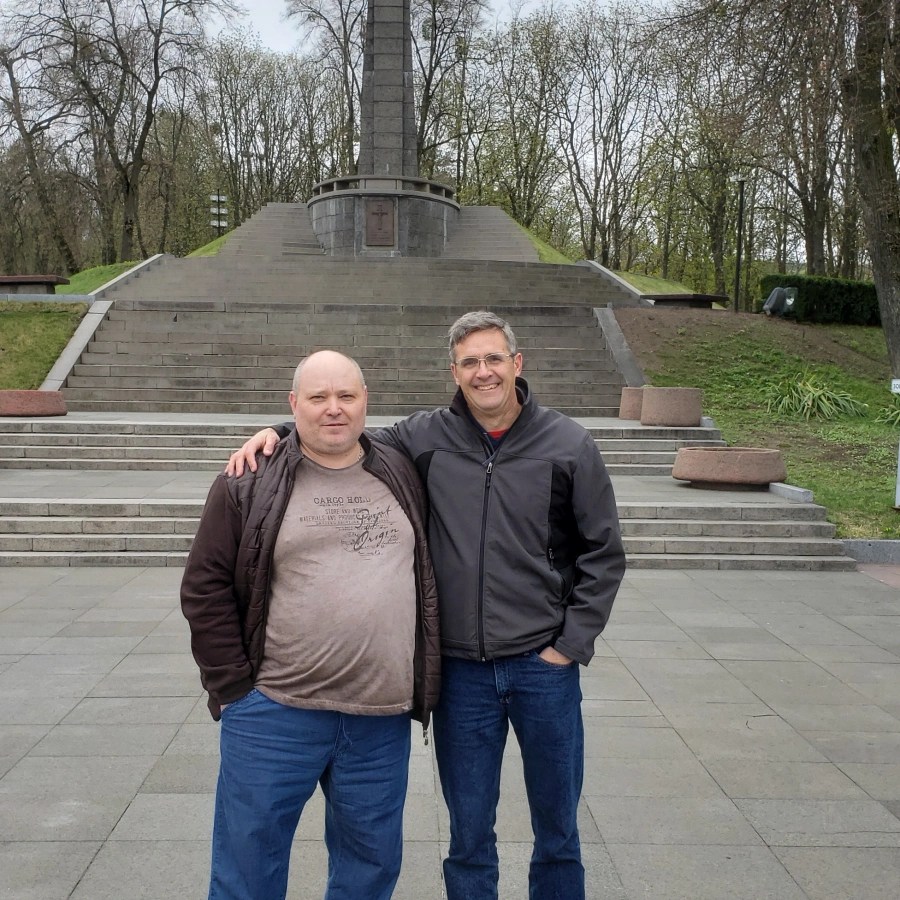
Left: Zhenya and me in Leningrad, Soviet Union, in 1989. Right: Zhenya and me in Khaniv, Ukraine, 2019.
All this to say that when I read about BUK 102 in my grandfather’s memoir, I understood that Zhenya was living what Lev Hloba and his comrades had fought for.
During a visit to Ukraine in 2019, Zhenya showed me important places in Ukrainian history – the birthplace and grave of Ukrainian poet Taras Shevchenko and the long and wide Dnipr River. But most of our conversations driving in his car across the flat plains of central Ukraine wound back to Ukraine’s predicament as a country haunted by its Soviet past. . . and beleaguered by its Russian present in the form of a Kremlin-backed insurgency in eastern Ukraine and the illegal seizure of Crimea in 2014. If he were young, Zhenya told me in 2019, he would grab a gun and go fight Russian-backed forces in the east.
Then Russia invaded Ukraine in 2022.
Europe and the U.S. have coalesced to support Ukraine as it fends off the bigger and more well-equipped Russian military. Zhenya’s work as head of the grain export department of a Ukrainian company has tanked because of the war. He asked for help to get his daughter and son-in-law to the U.S. so that the son-in-law, a talented chemical engineer, could take up a fellowship at the University of California Berkeley.
***
Ukraine’s heroic efforts to repel Russia from some of its territory in 2022 motivated me to look into the fate of the BUK 102 soldiers, who also had to fight to be free. The first step was going to Confracourt in October 2022 to retrace my grandfather’s steps some eighty years later.
I was honored like a visiting emissary by the citizens of Confracourt, who organized a tour – randonée á pied, in French – of the key places connected to the OSS team’s mission: the drop zone for the parachute landing, the Confracourt woods, the church from whose steps Burke and Kuzmuk watched the celebration of Confracourt’s liberation, and the spot where André Bazeau’s tortured corpse was found.
By making the visit, I understood that I was the latest in a line of family members to make a pilgrimage to Confracourt. A sacred pilgrimage, you might say. You see, grandfather believed André Bazeau had saved his life by refusing to divulge the presence of the OSS contingent in the woods. In grandfather’s view, Bazeau had preserved grandfather’s life by sacrificing his own. Grandfather even wrote an article entitled “The Shrine” about Bazeau’s heroic service for The News and Courier of Charleston, SC. In 1964.

Grandfather returned to Confracourt for the first time in 1953 with my grandmother and mother. Then he returned several times in the ensuing decades. At each visit, photos were taken, acquaintances renewed, and memories rekindled of the liberation of Confracourt and the sacrifice of André Bazeau.

During the 1953 visit to Confracourt, grandfather posed with Claude Vougnon and his family. From l to r: unknown woman, Waller Booth, Claude Vougnon’s wife and children, Dorothy Booth, Claude Vougnon, and Sally Lilley (neé Booth). Photo courtesy of Chrissie Crawford.
On the randonée á pied, our group arrived at the monument in the woods honoring three members of the Confracourt maquis who had been killed during the war. It was the same monument at which my grandfather had paid homage during visits over the decades. Two of the three honored maquisards were André Bazeau and Simon Doillon. Yes, the brave and intrepid Doillon, the mastermind behind BUK 102’s revolt, who had been felled by a German sniper’s bullet on October 7, 1944.
Josette Bussy-Bazeau, the daughter of André Bazeau, who was just two when her father was killed during the war, joined us for a ceremony at the monument organized by the mayor of Confracourt. There, before the mayor spoke, I delivered to Josette a letter my mother had written to her. In it, my mother wrote: “You had to grow up without your father, the marvelous André Bazeau, while I had the great pleasure of knowing my father for decades.”

Local dignitaries and relatives of members of the French Resistance line up in front of the monument to the martyrs in the Confracourt Woods in October 2022. Josette Busy-Bazeau, the daughter of Andre Bazeau, is holding the manila folder with the letter from my mother.
In his speech at the monument, the mayor of Confracourt recalled the history of the local maquis and the arrival in September 1944 of the OSS contingent headed by Grandfather. He noted as well that the celebration at the monument took on more significance because of the war in Ukraine.
In my own speech, I underscored the need to counter Russia’s unprovoked aggression with the same kind of unity that had propelled the allies to victory against Nazi Germany. “The bonds that tied together French, Americans and Ukrainians 78 years ago must be strong again today, and any sacrifices we make must be inspired by the memory of men like André Bazeau,” I said.
The fate of BUK 102’s soldiers figured prominently in my thoughts, as did grandfather’s role in helping secure their freedom.
I stay in touch with Zhenya who has remained in Ukraine since the start of war because he is of fighting age, meaning between the ages of 18 and 60. Our Whatsapp chats careen back and forth between updates on the war, Zhenya’s calls for the U.S. to do more to help Ukraine, and his daughter and son-in-law’s new life in California. “At least some members of my family are safe,” Zhenya says. He knows the history of my grandfather helping the Ukrainians and has become a sort of assistant researcher for me, scouring Ukrainian and Russian language sources for information on BUK 102.
“They have to make a film about your grandfather,” Zhenya wrote me. “He was one of the most impressive spies of the 20th century.” I tell Zhenya on the phone that after the war’s over he’s going to help me track down relatives of the soldiers in BUK 102.
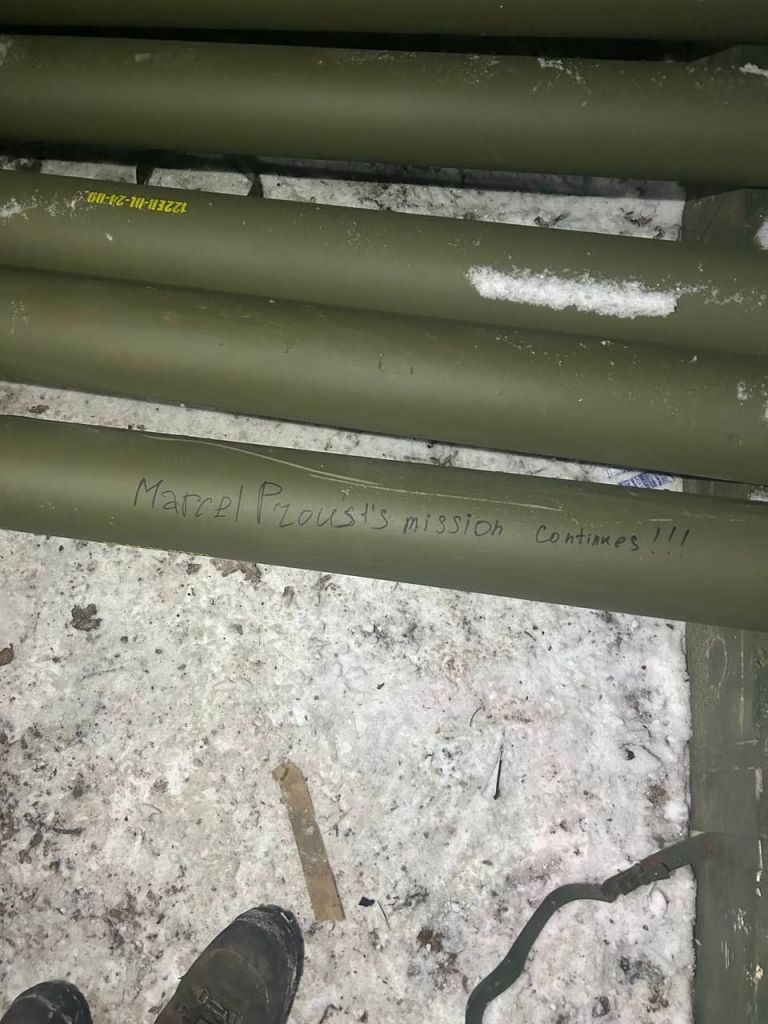
Thanks to Zhenya, grandfather’s story is alive in Ukraine today. You see, his nephew Maksim, who helped to defend Kyiv in the first days of the war, is fighting on the frontlines in the east. Zhenya has spread the word of BUK 102 and Waller Booth to Maksim’s platoon. Apparently, Maksim and his comrades-in-arms have been inspired by grandfather’s joint mission with BUK 102. Take a look at what Maksim wrote on the rocket at the bottom of the photo. Those missiles were fired on January 5, 2025 as part of Ukraine’s attack against Russian and North Korean troops in Russia’s Kursk Oblast.
It’s hallowed ground to me, as it was for my grandfather. Decades later we are asked to come together again with our French and Ukrainian allies, this time not for French freedom but for Ukrainian freedom.
If you have questions or information about Mission Marcel Proust, the Ukrainians or anything else I have written, contact me at jbealllilley@gmail.com
 Jeffrey Lilley Writing